
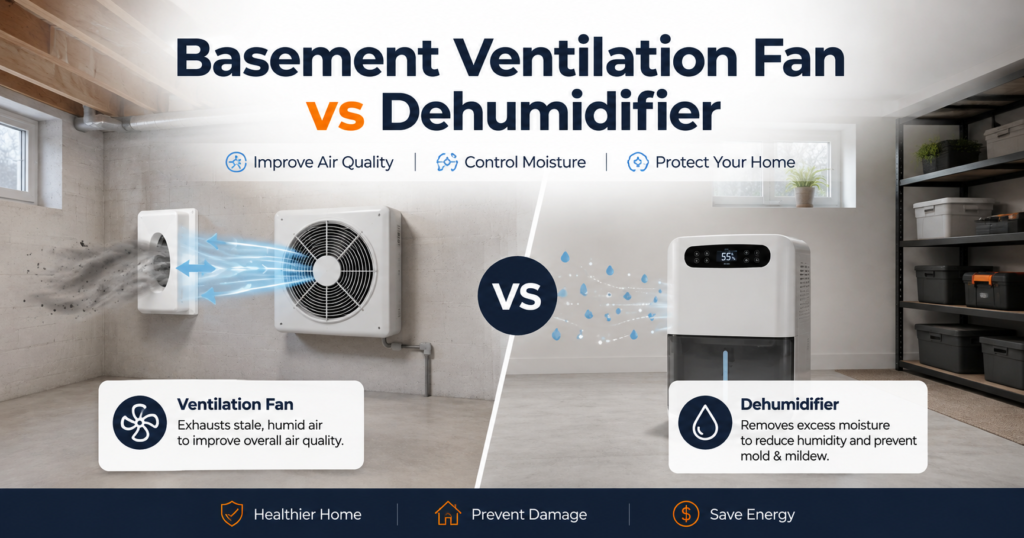
Quick answer: A basement ventilation fan and a dehumidifier solve different problems. Ventilation moves or replaces indoor air, while a dehumidifier removes moisture from the indoor air. If the basement mainly feels stale or stuffy and humidity is already under control, planned ventilation may help. If relative humidity stays high, first look for the moisture source and reduce indoor moisture—often with a dehumidifier. In many basements, the right answer is a combination of both.
Important: Do not rely on a general basement ventilation fan or a dehumidifier to fix foundation leaks, standing water, active plumbing leaks or a radon problem. Correct water-entry problems first, and use radon-specific testing and mitigation when needed.
Ventilation Fan vs. Dehumidifier: The Core Difference
| Device | What it changes | Best starting point for | Main limitation |
|---|---|---|---|
| Ventilation fan | Air movement and air exchange | Stale air and indoor pollutants or odors after their source has been identified or controlled | It does not remove moisture the way a dehumidifier does. Incoming replacement air may also be humid. |
| Dehumidifier | Indoor moisture level | Persistent high relative humidity and damp conditions after water-entry problems are addressed | It does not intentionally provide fresh outdoor air or remove every indoor pollutant source. |
| Balanced ventilation, often using an HRV or ERV | Controlled supply and exhaust airflow | Finished or regularly occupied basements that need planned fresh-air exchange as part of the home’s ventilation system | More complex and usually more expensive to design and install. |
An exhaust fan deserves one extra explanation. It pushes air out of the basement, but that air has to be replaced from somewhere. Replacement air may enter through planned vents, other parts of the house or gaps in the building. That is why a good ventilation plan considers both the air leaving the basement and the air coming back in.
Start With the Problem, Not the Appliance
Basements can be damp for several reasons at the same time. Liquid water can enter through the foundation, moisture can move through building materials, indoor activities can add humidity, and warm humid outdoor air can condense on cool basement surfaces. EPA guidance puts source control first: repair leaks and seepage, dry wet materials quickly and keep indoor humidity under control.
Choose controlled ventilation first when…
- The basement feels stale or stuffy even though humidity is already under control.
- You need to reduce indoor pollutants or lingering odors after their source has been identified or corrected.
- The basement is part of a broader whole-house ventilation plan.
- A finished or regularly occupied basement needs planned fresh-air exchange instead of depending on random air leakage.
- The system has a safe and suitable path for replacement or supply air.
Choose dehumidification first when…
- Relative humidity remains elevated even after obvious leaks and water intrusion have been addressed.
- The basement becomes damp during warm or humid weather.
- Cool walls, floors, pipes or ducts are prone to condensation.
- Bringing in outdoor air would add more moisture than it removes.
Why Ventilation Can Make a Basement Wetter in Summer
Relative humidity changes with temperature. A basement is often cooler than the outdoor air, so warm humid air entering the basement can cool down when it reaches walls, floors, pipes or ducts. If a surface is cold enough, moisture can condense on it.
This is why opening basement windows or running a fan simply because it is summer can sometimes make a damp-basement problem worse, especially in a humid climate.
Dew point can be more useful than outdoor relative humidity when deciding whether outdoor air will help. Dew point gives you a better idea of how much moisture is actually in the air. A high outdoor dew point means the outdoor air contains a lot of moisture, even if the relative-humidity percentage does not look extreme.
A humidity-controlled exhaust fan also cannot tell, by itself, whether the replacement air entering the home is drier than the basement air. If the outdoor air contains more moisture, the fan may increase the basement’s moisture load instead of reducing it. In those conditions, a dehumidifier may be doing the more useful moisture-control work.
When Using Both Makes Sense
Ventilation and dehumidification are not competing solutions. They do different jobs. A finished or regularly occupied basement may need fresh-air ventilation for indoor air quality and a dehumidifier for moisture control. The ventilation system handles air exchange; the dehumidifier removes excess moisture that remains after leaks and other moisture sources have been addressed.
An ERV can reduce some of the heat and moisture load that comes with bringing outdoor air into the home, but it should not automatically be treated as a replacement for a dehumidifier when basement humidity remains high.
| Situation | Better first move | Possible second move |
|---|---|---|
| Stale air, RH in a reasonable range | Controlled ventilation | Monitor RH and add dehumidification only if needed |
| Persistent RH above the desired range | Moisture-source investigation + dehumidification | Add planned ventilation if air quality still requires it |
| Warm-humid outdoor weather | Avoid uncontrolled outdoor-air flushing | Dehumidify and use planned ventilation when needed |
| Finished or regularly occupied basement | Include the basement in the home’s overall ventilation strategy | Add dehumidification if RH still runs high |
| Foundation leak / standing water | Repair the drainage, waterproofing or plumbing problem | Dry the space, then reassess ventilation and humidity |
| Radon concern | Test and use a radon-specific mitigation approach when needed | Do not substitute a general basement exhaust fan |
What Humidity Level Should You Watch?
EPA recommends keeping indoor relative humidity below 60%, with 30% to 50% as an ideal general indoor range when practical. In a basement, use a reliable humidity meter and watch the trend over several days instead of reacting to a single reading.
For a deeper explanation of seasonal targets, sensor placement and what to do at 55%, 60% or 70% RH, see our basement humidity guide.
A Simple Decision Process
- Check for liquid water first. If you have leaks, seepage, wet materials or standing water, repair the source before depending on a fan or dehumidifier.
- Measure humidity. Do not diagnose a damp basement by smell alone. Use a humidity meter and watch how the readings change over several days.
- Identify the air-quality problem. Stale air and high humidity can happen together, but they are not the same problem.
- Consider outdoor conditions. Outdoor air is not automatically dry air. During warm humid weather, bringing it into a cool basement can add moisture.
- Think about where replacement air will come from. An exhaust fan pushes air out, so air has to enter the house somewhere else.
- Check combustion and radon safety. Exhaust fans change air pressure inside the home. In homes with natural-draft furnaces, boilers or water heaters, a strong exhaust system can sometimes interfere with the safe removal of combustion gases. Radon also requires its own testing and mitigation decisions.
- Choose the system that solves the actual problem. Ventilate for air exchange, dehumidify for moisture removal, and use both when the home needs both.
Before Choosing a Basement Fan Size
Do not choose a basement fan only because it has a high CFM rating or because a simple calculator recommends a certain number of air changes per hour. The right airflow depends on why you are ventilating, where replacement air will come from, how the basement connects to the rest of the house and whether combustion appliances or other exhaust fans are operating nearby.
More airflow is not automatically better. A properly planned system should move enough air to solve the ventilation problem without creating unnecessary noise, energy use or unwanted pressure inside the home.
COMMON QUESTIONS
Frequently Asked Questions
Will an exhaust fan lower basement humidity?
Sometimes, but not in every climate or season. An exhaust fan removes basement air, which means replacement air has to enter from somewhere. If that incoming air contains less moisture, ventilation may help. If the incoming air is warm and humid, the fan can add moisture instead. Outdoor dew point is often more useful than relative humidity alone when judging whether outside air will help.
Is a dehumidifier enough for a musty basement?
It can help when high humidity is part of the problem, but a musty smell can also point to hidden water intrusion, damp materials or microbial growth. Find and correct the moisture source instead of relying on the dehumidifier to hide the symptom.
Can I run a dehumidifier and ventilation fan together?
Yes. They perform different jobs. Planned ventilation can provide fresh-air exchange while a dehumidifier removes excess indoor moisture. This combination can make sense in a finished or regularly occupied basement.
Should I open basement windows instead of using a dehumidifier?
Only when outdoor conditions are actually favorable. Warm humid outdoor air can add moisture to a cool basement and may condense on cold walls, floors, pipes or ducts. During humid weather, keeping the windows closed and using dehumidification may be more effective.
Does a ventilation fan fix radon?
Do not treat a general basement ventilation fan as a radon-mitigation system. Test the home for radon and, when needed, use an established radon-reduction method designed for that purpose.
Can a basement exhaust fan cause problems with a furnace or water heater?
It can in some homes. An exhaust fan pushes indoor air outside and changes the air pressure inside the building. If the home has a natural-draft furnace, boiler or water heater, strong exhaust airflow can sometimes interfere with the way combustion gases leave the home. The system should have a safe path for replacement air, and questionable installations should be checked by a qualified professional.