
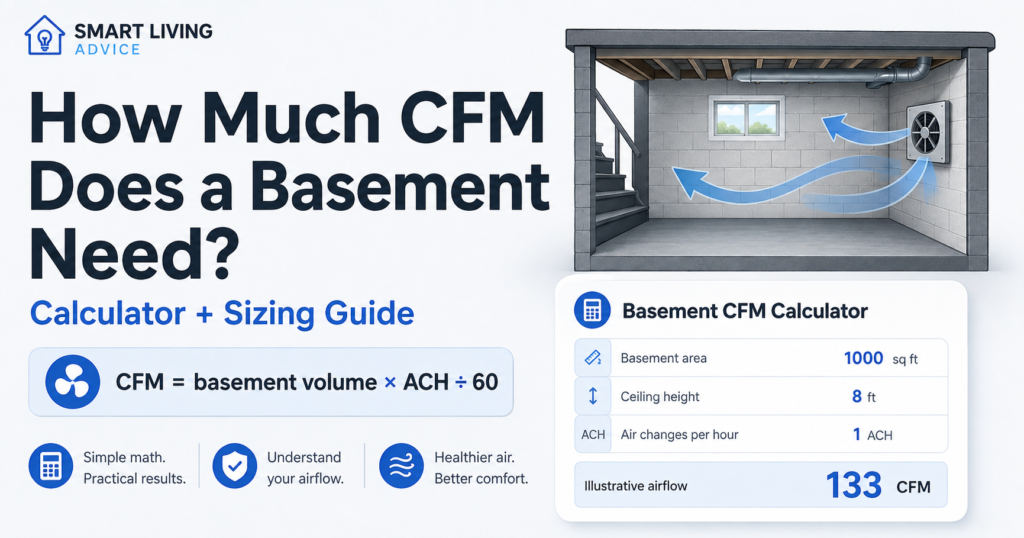
Quick answer: There is no single CFM number that is correct for every basement. A useful educational calculation is CFM = basement volume × target air changes per hour ÷ 60, but that result is not a universal code requirement or a complete HVAC design. Finished-space occupancy, the purpose of ventilation, outdoor air, pressure effects, local code and combustion appliances can all change the right system.
Sizing note: Use the calculator below to understand airflow math, not as a substitute for local code, ASHRAE 62.2 design, manufacturer instructions or an HVAC professional.
Basement CFM Calculator
This calculator explains airflow math. It does not prescribe a basement ventilation rate or determine code compliance.
How the CFM Formula Works
Step 1: Calculate basement volume. Multiply floor area by average ceiling height. A 1,000-square-foot basement with an 8-foot ceiling contains about 8,000 cubic feet of air.
Step 2: Choose an illustrative ACH value. ACH means air changes per hour—the theoretical number of times an airflow volume equals the room volume in one hour.
Step 3: Convert to CFM. Multiply volume by ACH and divide by 60 minutes.
| Example basement | 0.5 ACH | 1 ACH | 2 ACH |
|---|---|---|---|
| 500 sq ft × 8 ft = 4,000 cu ft | 33 CFM | 67 CFM | 133 CFM |
| 1,000 sq ft × 8 ft = 8,000 cu ft | 67 CFM | 133 CFM | 267 CFM |
| 1,500 sq ft × 8 ft = 12,000 cu ft | 100 CFM | 200 CFM | 400 CFM |
Why the Calculator Is Not a Code Sizing Tool
Residential ventilation is not designed from basement square footage alone. ASHRAE 62.2-2025 is the current residential ventilation and indoor-air-quality standard and includes requirements for dwelling-unit ventilation, local exhaust and source control. Local building codes may adopt a particular edition or use their own requirements.
EPA also uses air exchange rate to explain how outdoor air replaces indoor air, but consumer examples should not be treated as a one-number design rule for every basement. A finished basement that becomes living space may need to be considered as part of the dwelling’s overall ventilation strategy.
What CFM Rating Should You Look At on a Fan?
A fan’s advertised CFM is a useful comparison point, but installed airflow can differ from a headline rating. Duct length, elbows, grilles, wall caps, filters and static pressure can reduce delivered airflow. For a through-wall product, manufacturer documentation may specify performance differently than for a ducted ERV.
This is also why a very large fan is not automatically better. High exhaust airflow can create negative pressure and increase uncontrolled replacement air. In a basement with naturally drafted combustion appliances, pressure effects deserve professional attention.
Match Airflow to the Purpose
| Purpose | What matters besides CFM |
|---|---|
| Occasional stale-air purge | Runtime, outdoor conditions, makeup air, noise |
| Humidity-triggered exhaust | Outdoor moisture, sensor logic, source control, replacement air |
| Finished occupied basement | Whole-home ventilation strategy, filtration, comfort, balanced airflow |
| Workshop / utility purge | Contaminant source, exhaust location, makeup air, combustion safety |
| Continuous ventilation | Code/standard design, measured installed airflow, energy use, controls |
CFM vs. ACH: Which Number Matters More?
CFM is the fan airflow rate. ACH relates that airflow to the volume of the space. Neither tells the whole story by itself. A 200-CFM fan is a very different intervention in a 500-square-foot basement than in a 2,000-square-foot basement, and two basements of the same size can still need different ventilation strategies.
For a deeper explanation of air-change math, natural infiltration and why old “one ACH number fits all” rules are misleading, read Air Changes per Hour (ACH) Explained.
Combustion Safety Before High-CFM Exhaust
DOE Building Science Education notes that negative pressure can contribute to backdrafting of natural-draft fuel-burning appliances. If the basement contains an atmospherically vented furnace, boiler, water heater, fireplace or similar appliance, have the system evaluated before installing high-capacity exhaust.
COMMON QUESTIONS
Frequently Asked Questions
How many CFM do I need for a 1,000-square-foot basement?
With an 8-foot ceiling, the space contains about 8,000 cubic feet. The math is about 67 CFM at 0.5 ACH, 133 CFM at 1 ACH and 267 CFM at 2 ACH. Those are illustrations, not prescribed ventilation rates.
Is 200 CFM enough for a basement?
It depends on volume, purpose, runtime and the building. In an 8,000-cubic-foot basement, 200 CFM is about 1.5 theoretical air changes per hour before installation losses.
Should I buy the highest-CFM fan I can?
No. Oversized exhaust can be noisy, waste conditioned air and create stronger negative pressure. Choose a system for the use case and building conditions.
Does a dehumidifier CFM count as ventilation CFM?
No. A portable dehumidifier circulates indoor air through the appliance but does not intentionally exchange that air with outdoors.
Does ASHRAE require a specific basement ACH?
ASHRAE 62.2 is a dwelling-unit ventilation standard, not a universal basement-ACH rule. Use the locally adopted requirements and professional design for compliance.