
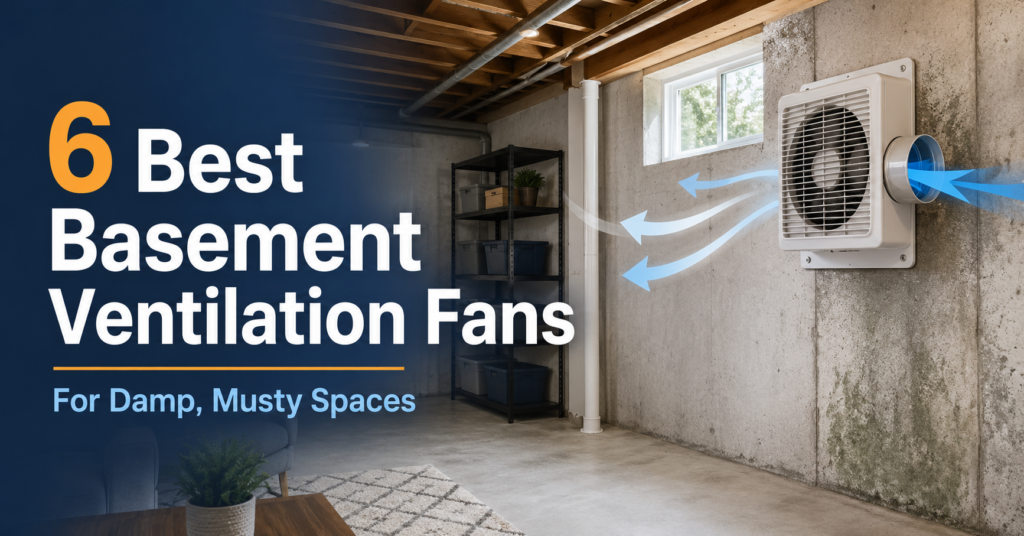
Choosing a basement ventilation fan is not simply a matter of buying the model with the highest CFM. The right option depends on whether you are dealing with stale air, excess humidity, an unfinished utility basement or a finished living space. After comparing current manufacturer specifications, controls, installation requirements and basement suitability, the Tjernlund X2D Xchanger is our top research-based pick for most unfinished basements.
If smart humidity and temperature control are your priorities, the AC Infinity AIRTITAN T8 is the stronger option. For a finished basement used as regular living space, a balanced energy-recovery ventilator such as the Panasonic WhisperComfort 60 can make more sense than a large exhaust-only fan.
Affiliate disclosure: This article contains affiliate links. We may earn a commission if you buy through our links, at no additional cost to you. As an Amazon Associate I earn from qualifying purchases.
RESEARCH SNAPSHOT
6 recommendationsMatched to different basement use cases
Weighted methodologySuitability, airflow, controls, installation and noise
Primary documentationManufacturer specifications and manuals
Independent safety sourcesEPA mold, moisture and radon guidance
Testing transparency: This is a research-based guide. We do not present manufacturer specifications as firsthand test results. See exactly how we ranked the fans.
QUICK ANSWER
Our Top Picks at a Glance
BEST FOR MOST UNFINISHED BASEMENTS
Tjernlund X2D
180 CFM • reversible supply/exhaust • adjustable humidity control.
Choose it if: You want a purpose-built basement air-exchange system rather than a generic exhaust fan.
BEST SMART OPTION
AC Infinity AIRTITAN T8
240 CFM • app monitoring • humidity and temperature automation.
Choose it if: You want the fan to respond automatically to changing basement conditions and provide app-based monitoring.
BEST FOR FINISHED BASEMENTS
Panasonic WhisperComfort 60
Balanced ERV • filtration • selectable continuous airflow with 60-CFM boost.
Choose it if: Your basement is regularly occupied and balanced fresh-air ventilation matters more than maximum exhaust airflow.
Quick Comparison
| Product | Best for | Airflow | Ventilation / controls | Main drawback | Retailer |
|---|---|---|---|---|---|
| Tjernlund X2D | Best for most unfinished basements | 180 CFM | Reversible supply/exhaust • dehumidistat | Higher cost than a basic exhaust fan | Check Price on Amazon |
| AC Infinity AIRTITAN T8 | Best smart option | 240 CFM | Exhaust • app • humidity/temperature automation | Exhaust-only | Check Price on Amazon |
| AlorAir VentirPro 260S | Simple humidity control | 260 CFM | Exhaust • adjustable humidistat | No smart monitoring or balanced airflow | Check Price on Amazon |
| Broan-NuTone 509 | Through-wall exhaust | 200 CFM | Exhaust • optional external controls | Relatively loud at 8.5 sones | Check Price on Amazon |
| iLiving ILG8SF10VC | Large utility spaces | Up to 820 CFM | Exhaust • variable speed • humidity/temperature control | Too powerful for many basements | Check Price on Amazon |
| Panasonic WhisperComfort 60 | Best for finished basements | 20–50 CFM continuous • 60 CFM boost | Balanced ERV • filtration | More complex installation | Check Price on Amazon |
Important: A ventilation fan is not a cure for foundation leaks, standing water or persistent groundwater intrusion. Correct active water-entry problems first. Ventilation can also add moisture when outdoor air is warmer and more humid than the basement.
How We Researched and Ranked These Fans
We researched current manufacturer specifications, manuals and product documentation for each fan in this guide. We did not perform hands-on testing of every model, so our recommendations are based on published performance data, installation design and suitability for common basement situations.
Why this matters: We rank products for the basement situation they are best suited to rather than rewarding the highest CFM or the longest feature list. A high-airflow exhaust fan can be the wrong choice for a small, finished or combustion-appliance-equipped basement.
- Basement suitability — 25%: preference for products designed for basements, crawlspaces, utility spaces or direct outdoor ventilation rather than simply adapting a general room fan.
- Ventilation design — 20%: whether the system is exhaust-only, reversible supply/exhaust or balanced ventilation.
- Airflow — 20%: useful CFM for the intended application rather than assuming the highest airflow is automatically best.
- Controls — 15%: humidity sensing, temperature automation, schedules, variable speed and smart monitoring where available.
- Installation — 10%: through-wall, rim-joist, foundation-vent and ducted installation requirements.
- Noise and practical limitations — 10%: sound, pressure effects, installation complexity and suitability for occupied spaces.
BEST FOR MOST UNFINISHED BASEMENTS
1. Tjernlund X2D Xchanger
Best for: Unfinished basements where a purpose-built, direct outdoor air-exchange system is practical.
Why we picked it: Unlike several products in this guide that are general exhaust or crawlspace-style fans, the X2D was specifically designed for basement air exchange and gives you more airflow flexibility than an exhaust-only fan.
The Tjernlund X2D stands out because basement ventilation is its intended application. The system uses two reversible 90-CFM fans, giving you up to 180 CFM total airflow. Each fan can be positioned for supply or exhaust, allowing the unit to be configured for stale-air exhaust, outdoor-air supply or a more balanced exchange.
An adjustable dehumidistat can trigger operation as humidity rises, while separate controls allow each fan to be switched individually. Installation is through a basement rim joist or exterior wall.
Key specifications: 180 CFM total • reversible supply/exhaust • adjustable dehumidistat • rim-joist/exterior-wall installation.
What we like
- Designed specifically for basement air exchange.
- Reversible fan configuration.
- Built-in humidity control.
- More flexible than a basic exhaust-only fan.
What to know
- Costs more than a simple foundation-vent fan.
- Cannot remove moisture from humid incoming outdoor air.
Bottom line: Our top research-based choice for a typical unfinished basement because of its basement-specific design, reversible airflow and integrated humidity control. Skip it if your primary problem is summertime humidity rather than stale-air exchange.
BEST SMART OPTION
2. AC Infinity AIRTITAN T8
Best for: Homeowners who want automated humidity control and app-based monitoring.
The AC Infinity AIRTITAN T8 combines dual fans with up to 240 CFM of exhaust airflow and a programmable controller. Temperature and humidity triggers, schedules and minimum-speed behavior can be configured from the controller and supported app.
This is a useful option when you want the fan to respond to changing basement conditions instead of running continuously. Monitoring humidity over time also helps you see whether ventilation is actually improving the space.
Key specifications: 240 CFM • humidity and temperature automation • Wi-Fi/Bluetooth controls • exhaust configuration.
What we like
- Strong smart-control feature set.
- Humidity and temperature triggers.
- Remote monitoring and schedules.
- Useful airflow for many unfinished basements.
What to know
- Exhaust-only rather than balanced ventilation.
- Replacement-air and pressure effects still need consideration.
Tjernlund X2D vs. AC Infinity T8: Choose the Tjernlund when flexible supply/exhaust operation matters most. Choose the AC Infinity when app monitoring and automated humidity/temperature controls are the priority.
Bottom line: Our preferred smart basement exhaust option when automation and humidity monitoring are priorities. Skip it if you need balanced supply and exhaust rather than negative-pressure exhaust ventilation.
COMPACT HUMIDITY CONTROL
3. AlorAir VentirPro 260S
Best for: Smaller basement or foundation openings where you want straightforward humidity-controlled exhaust.
The AlorAir VentirPro 260S provides 260 CFM of exhaust airflow in a compact stainless-steel housing. Its built-in humidistat can automatically start and stop the fan based on the selected humidity level, and low-temperature protection helps prevent operation during very cold conditions.
Key specifications: 260 CFM • adjustable humidistat • stainless-steel housing • cold-weather cutoff • IP55-rated fan.
What we like
- Simple automatic humidity control.
- Compact form factor.
- Stainless construction for damp environments.
- No app required.
What to know
- Basic one-direction ventilation.
- A humidistat does not know whether outdoor air is actually drier.
Why choose it over the AC Infinity: Pick the AlorAir if you want straightforward automatic humidity control without apps, Wi-Fi or smart-home features.
Bottom line: A practical compact choice for simple humidity-based exhaust. Skip it if you want balanced ventilation or detailed app-based humidity monitoring.
BEST THROUGH-WALL OPTION
4. Broan-NuTone 509
Best for: Direct through-wall exhaust in unfinished utility, laundry or workshop spaces.
The Broan-NuTone 509 is a straightforward through-wall fan rated at 200 CFM. Its integrated exterior wall cap removes the need for a long duct run, which can make it useful for retrofits where a suitable exterior wall is already available.
It is substantially louder than the quieter options in this guide, so we would reserve it for utility areas rather than a finished basement office, bedroom or TV room.
Key specifications: 200 CFM • through-wall installation • integrated exterior wall cap • optional external controls • 8.5 sones.
What we like
- Simple through-wall layout.
- Established manufacturer.
- No separate long duct run required in suitable installations.
What to know
- 8.5-sones sound rating is relatively loud.
- Not our first choice for finished living areas.
Bottom line: A straightforward wall-exhaust choice when simplicity matters more than low noise or advanced controls. Skip it if the basement is a bedroom, office or TV room where fan noise would be distracting.
BEST FOR LARGE UTILITY BASEMENTS
5. iLiving ILG8SF10VC
Best for: Large unfinished workshops, utility basements or open spaces that genuinely need high exhaust capacity.
The iLiving ILG8SF10VC is rated at up to 820 CFM and combines automatic shutters with variable-speed, temperature and humidity controls. That capacity is useful for fast air purging, but it is far more airflow than many residential basements need continuously.
High-airflow warning: A high-capacity exhaust fan can create substantial negative pressure, so replacement air and the presence of naturally drafted combustion appliances need to be considered before installation.
Key specifications: up to 820 CFM • variable speed • humidity and temperature control • automatic shutter • wall mounted.
What we like
- Very high airflow.
- Variable-speed operation.
- Humidity and temperature controls.
- Useful for large unfinished spaces.
What to know
- Too powerful for many small or finished basements.
- Pressure effects need careful consideration.
Bottom line: A specialized high-airflow option for large workshops and utility basements, not a universal recommendation. Skip it if you have a small or finished basement or have not evaluated replacement air and combustion-appliance backdraft risk.
BEST FOR FINISHED BASEMENTS
6. Panasonic WhisperComfort 60
Best for: Finished basement bedrooms, offices and family rooms where balanced fresh-air ventilation matters more than maximum exhaust CFM.
Not directly comparable to the exhaust fans above: The Panasonic WhisperComfort 60 is an energy-recovery ventilator rather than a basic exhaust fan. It supplies outdoor air and exhausts stale indoor air at the same time while recovering some heat and moisture between the two air streams. We included it because balanced ventilation may be the more appropriate solution for a regularly occupied finished basement.
Selectable continuous airflow and a 60-CFM boost mode make it better suited to a finished living space than a very large exhaust-only fan. Installation is more involved because the unit requires a properly designed ducted fresh-air and exhaust path.
Key specifications: selectable 20–50 CFM continuous airflow • 60 CFM boost • balanced ERV • MERV 13 filtration • wall or ceiling mounting.
What we like
- Balanced supply and exhaust.
- Better fit for finished occupied spaces.
- Energy-recovery design.
- Built-in filtration.
What to know
- More expensive and complicated to install.
- Does not replace a dehumidifier when moisture loads are high.
Bottom line: The best fit in this lineup for a regularly occupied finished basement where comfort, filtration and balanced ventilation matter. Skip it if you only need a simple low-cost exhaust fan for an unfinished utility space.
Which Basement Ventilation Fan Should You Choose?
Purpose-built basement air exchange with reversible supply/exhaust and humidity control.
Check Price on Amazon| Your situation | Our pick | Why |
|---|---|---|
| Typical unfinished basement | Tjernlund X2D | Purpose-built basement design with reversible supply/exhaust and humidity control. |
| Want smart humidity monitoring | AC Infinity AIRTITAN T8 | App monitoring plus humidity, temperature and schedule automation. |
| Want simple automatic humidity exhaust | AlorAir VentirPro 260S | Straightforward humidistat control without an app. |
| Need a basic through-wall exhaust fan | Broan-NuTone 509 | Simple direct wall installation where noise is not a major concern. |
| Large workshop or utility basement | iLiving ILG8SF10VC | High airflow with variable-speed and environmental controls. |
| Finished, regularly occupied basement | Panasonic WhisperComfort 60 | Balanced fresh-air ventilation and filtration instead of exhaust-only airflow. |
Basement Ventilation Fan vs. Dehumidifier: Which Do You Need?
A ventilation fan and a dehumidifier solve different problems. A ventilation fan exchanges indoor and outdoor air, while a dehumidifier removes water from indoor air without intentionally bringing outdoor air into the basement. The simplest rule is: ventilation moves moisture; a dehumidifier removes moisture.
This distinction matters in summer. Pulling warm, humid outdoor air into a cool basement can increase the moisture load and may encourage condensation on cooler surfaces. A fan is therefore not automatically the right answer to high relative humidity.
| Your basement problem | Better starting point |
|---|---|
| Stale or stuffy air | Controlled ventilation |
| Persistent high relative humidity | Dehumidifier plus moisture-source investigation |
| Musty odor | Find the moisture source; use ventilation only as part of the solution |
| Foundation leak or standing water | Repair water intrusion first |
| Finished, regularly occupied basement | Consider balanced ventilation |
| Radon | Dedicated radon testing and mitigation—not a general ventilation fan |
How to Use CFM When Choosing a Basement Ventilation Fan
CFM is useful for comparing fan capacity, but it should not be treated as a stand-alone sizing rule. Basement volume gives airflow context, while finished-space use, moisture sources, outdoor conditions, HVAC configuration, replacement air and runtime all affect whether a particular ventilation approach makes sense.
For a quick product-comparison reference, you can convert basement volume and an illustrative air-change value into CFM:
CFM = basement volume × illustrative air changes per hour ÷ 60
Use this result to understand airflow scale when comparing products. It does not prescribe a basement ventilation rate or determine code compliance.
Use the result as context when comparing the airflow ratings in this guide—not as a rule that the closest or highest-CFM fan is automatically the best choice. Ventilation type, controls, installed airflow and building conditions still matter.
Where Should a Basement Ventilation Fan Be Installed?
A suitable exhaust location may include an above-grade foundation wall, an existing foundation vent, a rim joist or properly designed ductwork to an exterior termination. The exact location depends on the fan design and the building.
- Exhaust stale air directly outdoors.
- Follow the manufacturer’s required clearances and weather-protection instructions.
- Provide a safe path for replacement air.
- Avoid exhausting into an attic, garage, another room or an enclosed wall cavity.
- Consider furnaces, boilers, water heaters, fireplaces and other combustion appliances before installing a high-CFM exhaust fan.
Safety note: Large exhaust fans can depressurize a basement. If the space contains a naturally drafted furnace, boiler, fireplace or water heater, consult a qualified HVAC professional before installing high-capacity exhaust ventilation.
Can a Basement Ventilation Fan Help Prevent Mold?
A ventilation fan can be part of a mold-prevention strategy, but it cannot compensate for an unresolved moisture source. Fix plumbing leaks, foundation water entry, poor drainage and wet materials first. If the basement stays humid, monitor relative humidity and use dehumidification when necessary.
Can a Basement Ventilation Fan Reduce Radon?
Do not rely on a general basement ventilation fan as your radon solution. Radon mitigation is a separate safety issue and usually requires a dedicated system designed to prevent soil gas from entering the home. If radon is a concern, test the home and use a qualified radon professional when mitigation is needed.
COMMON QUESTIONS
Frequently Asked Questions
Should I run a basement ventilation fan all the time?
Not necessarily. Continuous ventilation can be appropriate when a system is designed and sized for it. Exhaust-only fans may waste conditioned air or pull humid outdoor air into the building, so humidity controls, timers or demand-based operation can be more appropriate.
What humidity should a basement be?
A practical goal is to keep basement relative humidity below 60%, with roughly 30% to 50% often used as a preferred indoor range. If humidity remains persistently high, investigate moisture sources rather than simply installing a larger fan.
Is an exhaust fan good for a basement?
It can be. Exhaust fans remove stale indoor air, but they also create negative pressure and require replacement air to enter somewhere. For a finished or tight basement, balanced ventilation may be a better fit.
Will ventilation get rid of a musty basement smell?
Ventilation can dilute odors, but persistent musty smells often point to elevated humidity, damp materials, hidden water intrusion or microbial growth. Identify and correct the source rather than using airflow only to mask it.
Should I open basement windows in summer?
Not automatically. Warm outdoor air can contain more moisture than cool basement air, and that moisture can condense on cooler basement surfaces. Outdoor conditions matter more than the season alone.
Is a foundation-vent fan the same as an ERV?
No. A foundation exhaust fan pushes indoor air outdoors and relies on replacement air entering elsewhere. An ERV intentionally exchanges indoor and outdoor air while recovering some energy between the two air streams.
Which basement ventilation fan is best for a finished basement?
For a regularly occupied finished basement, balanced ventilation can be a better fit than a large exhaust-only fan. In this guide, the Panasonic WhisperComfort 60 is our preferred finished-basement option because it supplies outdoor air and exhausts stale air while providing filtration and energy recovery.
Is a smart basement ventilation fan worth it?
It can be if you want humidity and temperature automation, schedules or remote monitoring. The AC Infinity AIRTITAN T8 is our preferred smart option in this guide. If you only need straightforward automatic exhaust, a simpler humidistat-controlled fan may be more cost-effective.
Our Verdict
For most unfinished basements where direct outdoor air exchange makes sense, the Tjernlund X2D Xchanger is our top research-based recommendation because its reversible dual-fan design is specifically intended for basement ventilation.
Choose the AC Infinity AIRTITAN T8 instead if smart monitoring and automatic humidity or temperature controls are your priorities. For a finished basement that is regularly used as living space, consider a balanced system such as the Panasonic WhisperComfort 60 before installing a large exhaust-only fan.
Remember that ventilation is not a substitute for repairing foundation leaks, addressing persistent moisture or using a dedicated radon-mitigation system when one is needed.
Sources & Product Documentation
- Tjernlund — X2D Xchanger product information
- AC Infinity — AIRTITAN T8 product information
- AlorAir — VentirPro 260S specifications
- Broan-NuTone — Model 509 specifications
- iLiving — ILG8SF10VC specifications
- Panasonic — WhisperComfort 60 information
- U.S. EPA — Mold, moisture and indoor humidity guidance
- U.S. EPA — Radon action-level guidance